What It Takes to Activate Every SKU Globally

Global product content encompasses the approved visuals and product information required to represent an assortment accurately across markets, retailers and channels. For global brands, launching a product is therefore rarely the end of production. More often, it is the beginning of a long sequence of local adaptations.
The same product must appear with the right packaging in Paris, the right claims in New York and the right format on every retailer page in between. Assortments change by market; languages, labels, bundles and promotional packs multiply; each channel introduces its own specifications. A global product quickly becomes a network of local SKU and content variations, generating hundreds of individual requests from what began as one launch.
This is where global ambition meets a surprisingly local production model. Priority markets and hero products receive the full launch treatment, while smaller markets and long-tail SKUs wait for assets, adapt what already exists or move forward with incomplete content. The brand may be global but its ability to activate the full catalog is not.
The commercial cost of that inconsistency is increasingly visible. In Salsify’s 2025 consumer research, 54% of shoppers said they had abandoned a purchase because product content was inconsistent from one channel to another, while 71% had returned a product because it did not match its online listing. Baymard’s product-page benchmark similarly found that 62% of leading mobile commerce sites delivered a product-page experience rated “mediocre or worse.” Product content is no longer a finishing layer around commerce; it is part of the infrastructure on which commerce depends.
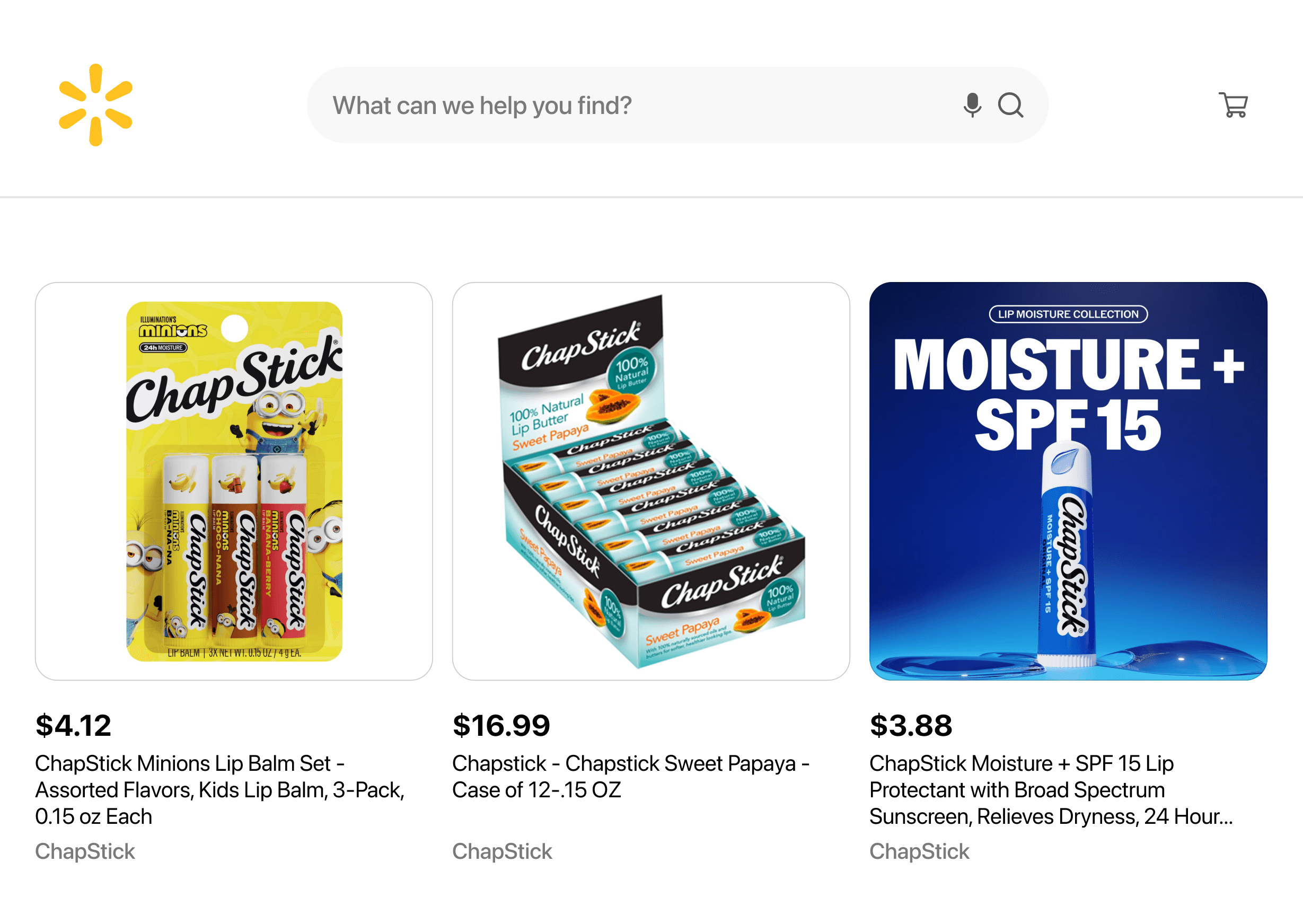
The hidden cost of market-by-market production
The difficulty is not simply the number of images required. It is the repeated work behind them. A new language triggers another adaptation; a local bundle becomes another brief; a retailer specification requires another export and approval cycle. Teams repeatedly reproduce the same bottle, jar or box because the surrounding context has changed.
At scale, this creates an uneven content economy. The most commercially important products are supported everywhere, while the rest of the catalog competes for limited production capacity. A team can generate thousands of assets and still leave a meaningful share of its SKUs without the content required to sell effectively.
Asset volume and SKU content coverage answer different questions. Asset volume records how much a team produced; SKU content coverage shows how much of the active assortment is genuinely ready to sell across its required markets, retailers and channels. The distinction matters because thousands of outputs can coexist with material gaps in the long tail of the catalog.
What SKU content coverage reveals
SKU content coverage measures how much of a brand's active assortment is supported by accurate, approved content across the markets, retailers and channels where those products are sold. Expressed as a ratio, it is the number of supported SKU-market-channel combinations divided by the total combinations the business needs to activate.
Consider a portfolio of 100 products sold in 10 markets across five channels. That creates as many as 5,000 potential product-content contexts before retailer-specific formats, local bundles or campaign variations are included. Managing those contexts as 5,000 independent projects is structurally inefficient. Measuring coverage makes the gaps visible and gives teams a more useful objective than asset volume alone.
Product information management (PIM) systems govern structured product data, while product content syndication distributes approved information to eCommerce and retailer destinations. Those systems are essential but they do not create missing imagery or resolve visual variation on their own. A scalable global product content operation connects that data and distribution layer to a governed visual product source, so each destination receives content that is both accurate and adapted to its requirements.

A scalable global product content model
A scalable global product content model uses one governed product source for each SKU and generates market-, retailer- and channel-specific content from that source. Rather than rebuilding or reshooting the product for every request, the brand creates and approves one accurate Digital Twin, then uses it to produce the local packs, angles, crops, compositions and formats required across the business.
In product-content operations, a Digital Twin is a governed digital representation of a physical product that preserves its approved shape, proportions, colors, materials, labels and finishes across content executions. It is distinct from the simulation and IoT twins used in manufacturing: its purpose is to serve as the authoritative visual source for eCommerce content, retailer content, campaigns and localized production.
The distinction is important. The product remains exact: its proportions, materials, colors, labels and finishes are governed centrally. Around it, teams can adapt language, claims, bundles, backgrounds and channel formats. Local variation no longer requires a new production workflow because the most sensitive element, the product itself, has already been approved.
For global teams, this creates a more elegant division of responsibilities. Central teams define the product truth, permissions and brand standards. Local teams work within that framework to activate the assortment for their own market. Governance is built into the source rather than added at the end of every production cycle.
From sequential rollout to simultaneous activation
Traditional global rollout is sequential by design. The central campaign is completed first, priority markets adapt it, approvals move back and forth, and each subsequent market waits for access to the same finite production resources. The process may protect consistency, but it also delays activation precisely where speed and local relevance matter most.
Once every SKU exists as an approved, governed source, markets no longer need to move in sequence. They can create the correct pack, retailer format or campaign variation in parallel, while the product remains consistent across every output. Review is still essential, but it can focus on what has genuinely changed, such as a local claim or composition, rather than repeatedly validating the product itself.
The result is not simply faster content creation. It is a different operating model: global control without a global queue, and local autonomy without local inconsistency.
Project-by-project production or a product-source model
The project-by-project model follows a familiar sequence: brief, produce, adapt, approve, deliver, then repeat for the next request. The product-source model begins with an approved product, then allows teams to localize and format it repeatedly within governed rules. One scales the number of projects; the other scales the value of the product source.

Accuracy becomes more valuable as content scales
The arrival of GenAI makes this product foundation even more important. AI can create environments, compositions and creative variations at remarkable speed, but it does not inherently know the difference between an approved pack and a plausible one. A subtle change to a label, cap, claim or shade may be visually convincing while remaining commercially wrong.
Digital Twins are important for GenAI product content because they give the model an approved product reference. GenAI can create environments and variations without being asked to reinterpret the product itself. For categories such as beauty, personal care, beverages and consumer goods, where packaging carries both brand equity and regulated information, that separation is fundamental: creative freedom can scale without leaving product fidelity to interpretation.
What this looks like at scale
Clarins: 1,200+ Digital Twins, 1,000+ visuals per month and 25+ markets activated monthly.
MegaFood: More than 20 launches supported each year, with launch-ready visuals produced in minutes rather than weeks.
Institut Esthederm: A bestseller launched across 13 markets on the same day, supported by 500+ renders for five channels.
Moët Hennessy: Retailer-specific packshots, angles and crops generated while maintaining the integrity of every bottle.
These examples span different categories and commercial models, yet the principle is consistent: the product is approved once, then activated wherever the business requires it. Production effort is no longer duplicated each time the market, retailer or channel changes.
Global product content management, measured by readiness
Global product content management is the discipline of governing, producing, localizing and distributing approved product content across the full assortment. Its starting point is not a new list of formats but a clear view of coverage: which active SKUs are missing the correct assets in which markets; where local teams are waiting for central production; which launches still depend on physical samples; and which retailer requirements repeatedly create new work.
Answering those questions reveals where a governed product source can create the greatest leverage. High-distribution SKUs, frequently changing packs and major launches are often the natural place to begin. From there, coverage can expand across the catalog until every market works from the same approved product foundation.
The ambition is straightforward: not more production but more complete activation. Every product should be ready for every market in which it has a commercial role, with the consistency expected from a global brand and the responsiveness required by local teams.
Frequently asked questions
What is global product content?
Global product content is the approved set of visuals and product information used to represent an assortment consistently across markets, retailers and channels. Global rollout is the process of localizing and distributing that content wherever each SKU is sold.
How do Digital Twins support content localization?
Product content localization adapts approved visuals and information to the language, packaging, claims, assortment and commercial requirements of a specific market. A Digital Twin preserves the approved product while teams make those local adaptations, allowing localization without restarting production.
How should brands measure global content performance?
Alongside output volume, brands should track SKU coverage by market and retailer, launch readiness, update turnaround time, content compliance and the proportion of local teams working from approved product sources.
How can brands scale product content globally?
Brands can scale global product content by maintaining one governed product source for each SKU, then using it to generate the packaging, compositions and formats required by local markets, retailers and channels. This reduces repeated production while preserving product accuracy.
How does GenAI support global product content?
GenAI can create environments, compositions and creative variations around an approved product representation. The Digital Twin keeps the product accurate while GenAI scales the context, allowing teams to localize content without asking the model to recreate the SKU itself.